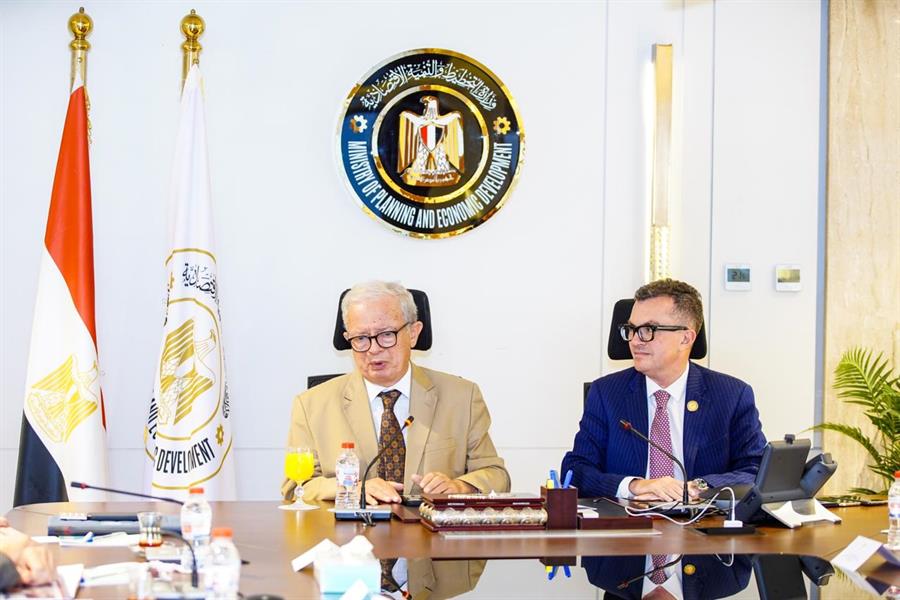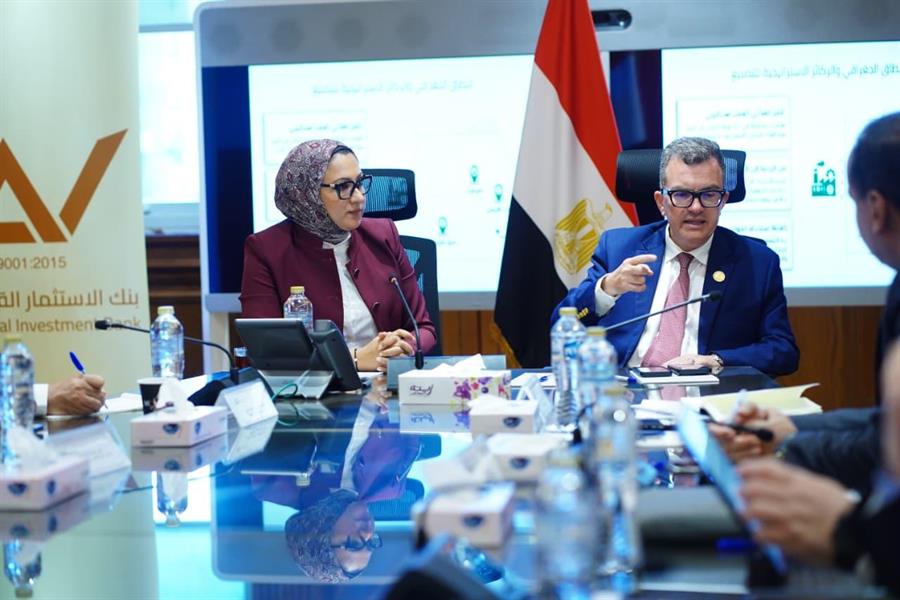
H.E. Dr. Rania Al-Mashat, Minister of Planning, Economic Development and International Cooperation, in Expanded Dialogues with Regional Media during WEF Davos Forum:

27 January 2026
H.E. Dr. Rania Al-Mashat, Minister of Planning, Economic Development and International Cooperation, in Expanded Dialogues with Regional Media during WEF Davos Forum:
Human development and social justice top the second edition of “Egypt’s Narrative for Comprehensive Development”.
The executive program of the Narrative includes clear, time-bound targets for ministries and various government entities through 2030.
Implementation of a “program and performance” budget and linking development impact to financial performance to ensure spending efficiency.
A targeted growth rate of 7.5% by 2030 and increasing the contribution of private sector investments to more than 70% of total investments.
Security and stability have been a fundamental pillar of Egypt’s economic growth in recent years despite regional challenges.
The government’s continued implementation of fiscal, monetary, and structural reforms has strengthened the economy’s resilience and enabled growth.
Achieved growth rates are driven by real, labor-intensive sectors such as industry, tourism, and communications.
Governance of public investments contributed to reducing spending and increasing private investments to 65% in the previous period.
H.E. President Abdel Fattah El-Sisi assured major global companies that the private sector is the main driver of development in Egypt.
Egypt’s Narrative includes details of the state’s efforts to empower the private sector and the issuance of the updated State Ownership Policy Document next March.
Offering airports to the private sector reflects the state’s serious orientation toward increasing its contribution to development efforts.
The government is working to stimulate real economic sectors that directly affect citizens’ living conditions.
$ 9.5 billion in international financing to support the budget during the IMF program period is linked to specific measures within the national structural reform program.
Egypt’s agricultural exports are gaining strong ground in global markets, driven by the state’s focus on food security and expansion of cultivated land.
International disruptions create challenges for international cooperation but open opportunities for regional integration, partnerships, and various alliances.
The global economy proved more resilient and achieved growth despite international tensions thanks to the strength of the private sector and ongoing technological advancement.
H.E. Dr. Rania
Al-Mashat, Minister of Planning, Economic Development and International
Cooperation emphasized that Egypt’s Narrative for Comprehensive Development aims
to transition toward an economic model that builds on achievements in
infrastructure investment in order to shift more strongly toward
higher-productivity sectors with greater access to export markets. This was
during expanded dialogues with regional and international media on the
sidelines of the World Economic Forum in Davos. She added that during the last
quarter of the previous year, societal dialogue, both structural and
interactive, was very rich, culminating in the release of the second edition last
December.
H.E. Dr. Al-Mashat
added that the most prominent feature of the second edition of Egypt’s
Narrative for Comprehensive Development is its strong focus on human
development, in light of the state’s prioritization of this vital sector due to
its direct connection to citizens, in addition to international cooperation and
partnerships, the green transition, and other priority sectors. This edition
also includes an executive program with specific timelines for achieving the
Narrative’s targets.
H.E. Dr. Al-Mashat
stressed that the Narrative’s theme is “Driving Economic Change, Enhancing
Quality of Life,” because the ultimate goal of all state policies and measures
is the citizen, across health, education, social protection, and enhancing
labor market efficiency. All macroeconomic reforms generate fiscal surpluses
that are used to increase spending on various human development sectors.
H.E. Dr. Al-Mashat
continued: “Another very important component is the existence of an executive
program for Egypt’s Narrative for Comprehensive Development. For the first
time, a program and performance budget will be implemented by linking the
government’s development performance to its financial performance, and by
committing to vertical targets for each ministry through 2030, as well as
horizontal targets that bring together different entities and ministries. To
reach 7.5% economic growth by 2030 and raise private sector investments to more
than 70%, each ministry has clear objectives and a clear mechanism for monitoring
implementation.”
Regarding Egypt’s
economic growth exceeding 5% in the first quarter of the current fiscal year,
H.E. Dr. Al-Mashat mentioned that: “To interpret this figure, we must return to
H.E. President Abdel Fattah El-Sisi’s speech at Davos Forum. The President
highlighted security and stability in Egypt and efforts to establish peace in
the region as a fundamental pillar for growth and prosperity. Another factor is
the state’s fiscal, monetary, and structural reforms, which are implemented flexibly
and continuously, creating resilience within the Egyptian economy. Therefore,
despite the difficult conditions in fiscal year 2024/2025 and the contraction
of Suez Canal activities and the extractive sector, achieving 5.3% growth in
the first quarter of the current fiscal year was driven by industry, tourism,
and communications, real sectors involving manufacturing, employment, and
private and foreign investments, and contributing to increased Egyptian
exports, both services and goods.”
H.E. Dr. Al-Mashat
noted: “Economic growth is based on real sector activities despite the decline
in the Suez Canal’s contribution and the continued contraction of extractive
industries. On the expenditure side, private investments contributed 65% as a result
of public investment governance measures implemented by the state to make room
for the private sector. We are also seeing improvement in the trade balance.”
H.E. Dr. Al-Mashat
expected the Egyptian economy to achieve at least 5% growth in the current fiscal
year, with the possibility of exceeding this rate, driven by strong interest
from international companies entering Egypt’s industrial sector, in addition to
the major boom in tourism. The sector is witnessing diversification, especially
after the opening of the Grand Egyptian Museum, along with increased private
sector participation. H.E. President El-Sisi has also met with major global
companies and emphasized that the private sector is the main driver of
development in Egypt.
H.E. Dr. Al-Mashat
noted that Egypt’s Narrative for Comprehensive Development includes a full
section on the state’s role in economic activities and efforts to implement the
updated State Ownership Policy Document, scheduled for release in March. In
this context, the state is working to increase private sector participation in
airport management for the first time in the coming period, including Hurghada
Airport, one of Egypt’s largest airports. She underscored that the government
is working to stimulate real economic sectors to achieve greater momentum,
focusing on sectors that directly affect citizens and their living standards.
Accordingly, the Narrative prioritizes sectors with high employment multipliers
that generate direct jobs and additional indirect employment opportunities.
Regarding
international praise for the Egyptian economy and the USD 9.5 billion in
financing obtained to support the budget, she stated that these funds cover the
period from late 2023 through 2026, coinciding with the IMF program, which
amounts to approximately USD 8 billion. She explained that the USD 9.5 billion
was provided by international institutions and development partners, including
the European Union, the World Bank, and others, to support the budget, and that
all of this financing is linked to structural reforms stipulated in the
National Narrative for Comprehensive Development. In addition, there are
guarantee instruments to enable Egypt to issue international bonds at lower
cost.
H.E. Dr. Al-Mashat
added that the government adheres to a ceiling for public investments;
therefore, external financing has become prioritized and primarily directed
toward strategic needs and commodities, as well as expanding fiscal space for
public finances.
On the significant
development of agricultural exports, H.E. Dr. Al-Mashat reiterated that H.E.
President El-Sisi consistently emphasizes the priority of food security and
energy security alongside water security. She noted that substantial
investments have been made in agriculture and food security through massive
projects such as the New Delta and other agricultural lands. As a result, Egypt
has witnessed growth in agricultural production, higher productivity, and
leadership in numerous global markets. She added that this represents an
important entry point for agro-industrial development, that is why Egypt’s
Narrative prioritizes sectors such as agriculture, irrigation, tourism, and
information and communications technology, and includes future policies to
expand cultivated land.
Regarding
disruptions in international markets and challenges facing global international
cooperation, the Minister noted that the World Economic Forum has sounded the
alarm about the future of international cooperation. At the same time, these
disruptions have prompted countries to seek new alliances, pursue regional
integration, and remove obstacles to regional partnerships. Global instability
has created space for new forms of cooperation, as seen in statements by the
Prime Minister of Canada and in emerging alliances across Europe and Latin
America that had been stalled for years. Thus, there are significant
opportunities for new types of partnerships with other countries.
H.E. Dr. Al-Mashat
pointed out that the World Bank and the International Monetary Fund are the two
largest international institutions and therefore have an important role in
emphasizing the importance of alliances.
H.E. Dr. Al-Mashat explained that global economic growth, which exceeded expectations, is attributable to the resilience shown by the global private sector in confronting challenges and adapting to them. Another key factor is technology, particularly artificial intelligence (AI), which boosted global growth resilience against protectionist measures taken by the United States. As a result, global growth reached 3.3% despite geopolitical and economic tensions overall.
Dr. Rania Al-Mashat's interview with Sky News Arabia during the Davos Forum
-

-

-

-
 copied successfully