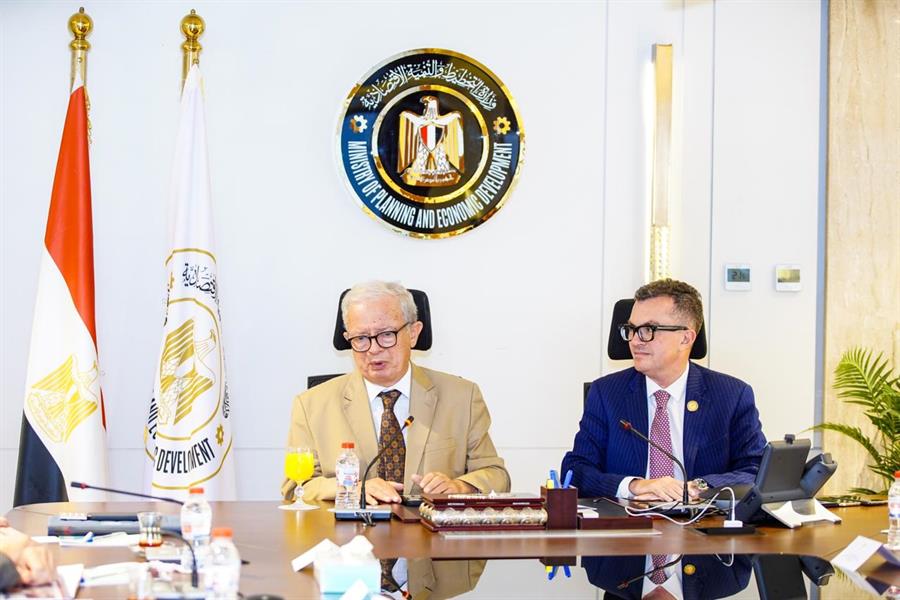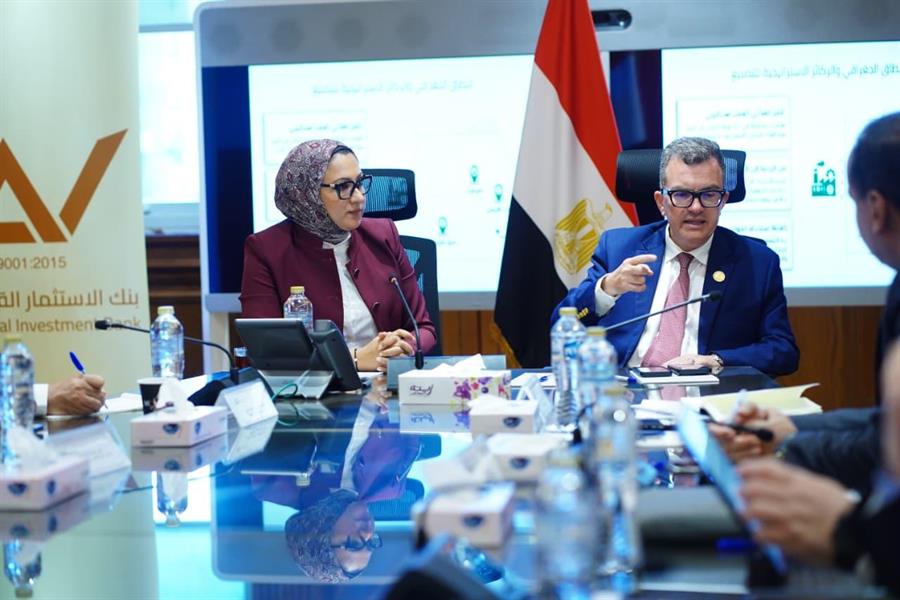
Minister of Planning, Economic Development and International Cooperation and Her Albanian Counterpart Conclude the First Session of the Joint Committee for Economic Cooperation
15 December 2025
First High-Level Ministerial Visit by an Egyptian Official to Albania in Nearly 20 Years
Minister of Planning, Economic Development and International Cooperation and Her Albanian Counterpart Conclude the First Session of the Joint Committee for Economic Cooperation
Al-Mashat signs two Memoranda of Understanding to exchange expertise in economic development policies and enhance joint investments between the two countries
Signing of the First Session Protocol of the Joint Committee, with both countries agreeing to explore partnership opportunities across 25 strategic sectors
Promotional and exploratory missions to boost investment relations and increase trade volume in line with the aspirations and potential of both countries
Discussion of cooperation in water resources and irrigation, higher education, scientific research, health, and population
Invitation extended to the Albanian side to explore investment and manufacturing opportunities in the Suez Canal Economic Zone as a gateway to African and Middle Eastern markets
Digital transformation, SMEs, urban planning, and food security identified as key priorities for future bilateral relations
Intensifying engagement between business communities and the private sector to create investment partnerships in areas of mutual interest
The first session of the Egyptian–Albanian Joint Committee
for Economic, Scientific, and Technical Cooperation concluded its meetings in
the Albanian capital, Tirana, co-chaired by H.E. Dr. Rania Al-Mashat, Minister
of Planning, Economic Development and International Cooperation, on the
Egyptian side, and Ms. Delina Ibrahimaj, Minister of Economy and Innovation of
the Republic of Albania, with the participation of relevant entities from both
countries.
The session was convened for the first time since the signing
of the Economic Cooperation Agreement between the two countries in 1993, and
marks the first high-level ministerial visit by an Egyptian official to Albania
in nearly 20 years.
Economic Development Policies
At the conclusion of the Committee’s meetings, H.E. Dr.
Rania Al-Mashat and her Albanian counterpart signed a Memorandum of
Understanding between the Ministry of Planning, Economic Development and
International Cooperation and Albania’s Ministry of Economy and Innovation to
exchange expertise in economic development policies.
The MoU aims to enhance and facilitate cooperation across
various areas to advance mutual interests and shared benefits. It includes
collaboration on the design and alignment of national and sectoral economic
policies to promote sustainable and inclusive economic growth, exchange
expertise in strategic planning at regional and sectoral levels, and strengthen
cooperation in the design and development of programs that enhance
institutional efficiency and sustainable economic development.
The MoU also targets the exchange of best practices in
national monitoring mechanisms for assessing the implementation of economic
reforms and the achievement of development objectives, as well as strengthening
the role of joint committees and subcommittees as tools to advance economic
diplomacy.
Investment Cooperation
In a related context, the two countries signed a Memorandum
of Understanding between Egypt’s General Authority for Investment and Free
Zones (GAFI) and the Albanian Investment Development Agency (AIDA). The MoU was
signed on the Egyptian side by H.E. Dr. Rania Al-Mashat, and on the Albanian
side by Mr. Laura Blaku (Saro), Executive Director of AIDA.
The agreement aims to enhance cooperation in providing
mutual support to investors, exchanging business delegations and visits, and
organizing matchmaking meetings to promote investment in both countries and
facilitate the establishment of joint ventures. It also includes the
organization of joint conferences and investor-focused seminars, as well as the
exchange of technical expertise through training programs, workshops, seminars,
and forums to share best practices in investment promotion, alongside the
exchange of experts to provide advisory services within specific projects and
programs.
First Session Protocol of the Joint Committee
The Co-Chairs of the Joint Committee also signed the
Protocol of the First Session, under which both countries agreed to strengthen
cooperation across 25 strategic sectors, including: trade and investment,
industry, tourism and antiquities, culture, petroleum and mineral resources,
electricity and renewable energy, water resources and irrigation, agriculture,
higher education, health and population, pharmaceuticals and medical supplies,
education and technical education, supply and internal trade, housing, labor,
endowments, environment, transport, Arab Organization for Industrialization,
information and communications technology, public business sector, youth and
sports, the Suez Canal Economic Zone, social solidarity, and small and medium
enterprises.
H.E. Dr. Al-Mashat affirmed that the Joint Committee
Protocol will contribute to strengthening trade relations and increasing
bilateral trade volume in line with mutual interests, through expanding
promotional and exploratory missions between relevant entities in both
countries. The two sides also agreed on the importance of establishing a joint
Egyptian–Albanian Business Council to play a pivotal role in advancing economic
relations and deepening engagement with the private sector.
Both countries further agreed to enhance cooperation in
investment by exchanging information, organizing exploratory missions, and
facilitating meetings between business communities, in addition to studying
opportunities for joint projects in food and engineering industries.
Cooperation will also be expanded in the tourism sector and in the field of
antiquities, leveraging the comparative advantages of both countries.
Priority Areas for Future Cooperation
Dr. Al-Mashat noted that cooperation will extend to water
resources and irrigation, higher education, scientific research, health and
population, as well as digital transformation, SMEs, urban planning, and food
security. She invited the Albanian government and private sector to explore
investment and manufacturing opportunities in the Suez Canal Economic Zone,
enhancing Albanian exports’ access to African and Middle Eastern markets.
The Protocol also covers cooperation in sustainable water
resource management, research projects on climate change adaptation, mechanisms
to increase crop productivity, and irrigation system development. It further
addresses collaboration in higher education and scientific research, as well as
health and population through partnerships aimed at developing healthcare
systems and building capacities.
Dr. Al-Mashat emphasized that the coming period will witness
intensified joint efforts and increased engagement between business communities
and the private sector to establish investment partnerships in areas of shared
interest.
The Protocol additionally includes cooperation in
pharmaceutical industries and medical supplies, education and technical
education, food security and strategic reserves management, development of
trade infrastructure, and cooperation with the Arab Organization for
Industrialization to meet Albanian needs in various industrial fields, spare
parts, and vehicles.
Other areas addressed include urban planning, labor mobility
regulation, endowments and religious affairs, environmental cooperation,
aviation and maritime transport, ICT and digital transformation in line with
national priorities, and public business sector partnerships and exports to the
Albanian market.
-

-

-

-
 copied successfully