H.E. Dr. Rania Al-Mashat and Minister of Investment and Foreign Trade Follow Up with the World Bank on the National Foreign Direct Investment Strategy and Egypt’s Narrative for Economic Development: Reforms for Growth, Jobs & Resilience
11 December 2025
In the Framework of Coordination and Integration Among the Economic Ministries
H.E. Dr. Rania Al-Mashat and Minister of Investment and Foreign Trade Follow Up with the World Bank on the National Foreign Direct Investment Strategy and Egypt’s Narrative for Economic Development: Reforms for Growth, Jobs & Resilience
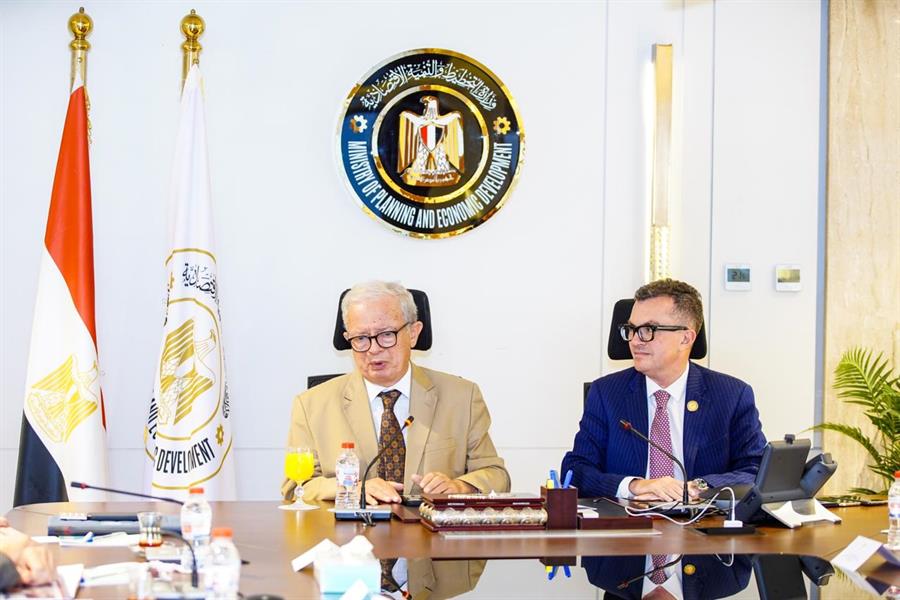
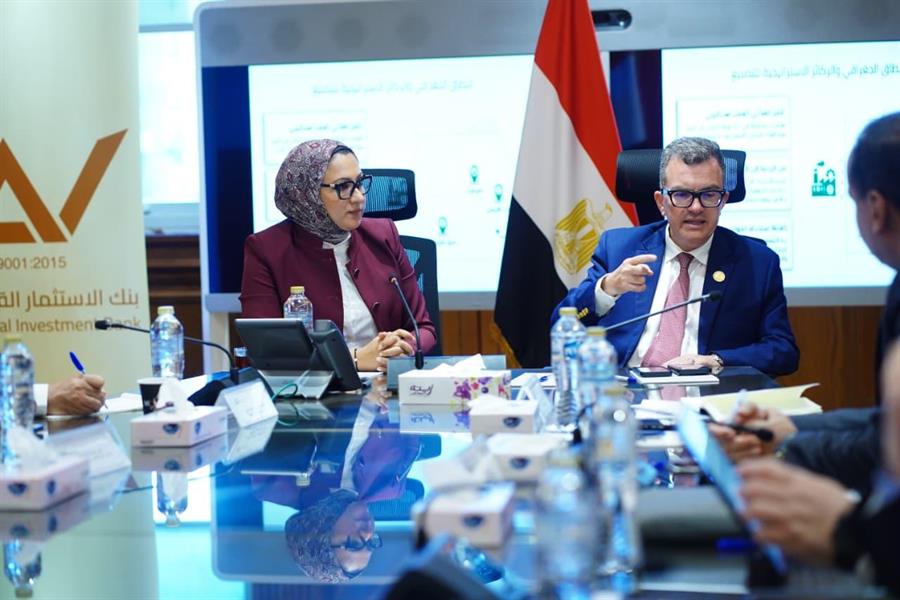
H.E. Dr. Rania Al-Mashat, Minister of Planning, Economic
Development and International Cooperation, and Eng. Hassan Al-Khatib, Minister
of Investment and Foreign Trade, held a meeting with a World Bank delegation to
discuss the progress of Egypt’s National Foreign Direct Investment (FDI)
Strategy and the main pillars of Egypt’s Narrative for Economic Development:
Reforms for Growth, Jobs & Resilience, which aims to transform Egypt’s
economic model toward production-oriented, high value-added sectors.
During the meeting, World Bank officials presented the final
draft of the National FDI Strategy and outlined the next steps regarding the
targeted sectors, aligned with Egypt’s national priorities and implementation
mechanisms. They also reviewed the global context of foreign direct investment
and the opportunities available to the Egyptian economy in light of its
substantial potential and comparative advantages.
H.E. Dr. Rania Al-Mashat, who also serves as Egypt’s
Governor at the World Bank, emphasized that the National FDI Strategy forms part
of Egypt’s ongoing efforts to diversify sources of economic growth and shift
toward higher-productivity sectors. She highlighted the alignment between
sectoral strategies, particularly in FDI and industrial development, to focus
on sectors with comparative advantages, boost development rates, and generate
employment opportunities.
H.E. Dr. Al-Mashat also noted the government’s efforts to
enhance the efficiency of public investment management, improve governance, and
set clear investment ceilings to limit inflation while creating more
opportunities for the private sector. She added that technical cooperation with
the World Bank in preparing the FDI strategy supports this approach and
implements directives from the Supreme Investment Council to establish a clear
vision for foreign investment in Egypt, further strengthening efforts to
attract and encourage foreign investment within Egypt’s Narrative for Economic
Development: Reforms for Growth, Jobs & Resilience.
For his part, Eng. Hassan Al-Khatib stressed that the next
phase will focus on activating and implementing the National FDI Strategy by
concentrating on priority sectors in which Egypt has clear competitive
advantages. This approach aims to attract higher-quality investments that
contribute to economic growth, create decent employment opportunities, and
expand local value chains in strategic sectors. He noted that the ministry is
coordinating with relevant ministers to develop and structure investment
opportunities that support Egypt’s promotion as an attractive investment
destination in these sectors.
The minister further explained that strengthening the
integration between the FDI strategy and foreign trade policies will be a key
focus in the upcoming period. The ministry seeks to link investment attraction
plans with export opportunities in regional and international markets, aiming
to support priority sectors in transitioning toward export-oriented production,
enhancing competitiveness, and creating broader opportunities for
high-value-added foreign investments.
He added that, in preparation for Egypt’s inclusion in the
World Bank’s “Business Ready” report, the ministry is coordinating with other
ministries and relevant authorities to enhance the readiness of Egypt’s
investment ecosystem. This will boost the country’s ability to achieve tangible
improvements in the report’s indicators. He emphasized that ongoing reforms
will have a significant impact on improving the business environment and
attracting more local and foreign investments. These reforms are based on
enhancing the legislative and regulatory framework, expanding digital
transformation, ensuring data availability and transparency, and increasing
operational efficiency by reducing time, costs, and procedures across the
project lifecycle.
The Minister concluded that focusing on this comprehensive
reform framework strengthens investor confidence and supports Egypt’s pursuit
of its sustainable economic development goals in line with Vision 2030.
During the meeting, the ministers reviewed the final draft
of the strategy and discussed its implementation on the ground, focusing on 13
strategic sectors: automotive and auto parts, electronics, pharmaceuticals and
medical supplies, chemicals, textiles and ready-made garments, agriculture and
food processing, renewable energy (solar and wind), green hydrogen, logistics
and transportation, hospitals and medical centers, hotels and tourist resorts,
outsourcing and communications services, and data centers. Of these, eight
sectors are ready for promotion, while five sectors are undergoing multiple
reforms.
The meeting also addressed promoting Egypt’s business and
investment environment and preparing the Business Ready report, which aims to
enhance the investment climate and attract foreign direct investment through a
wide range of reforms, legislation, and improved investor services within the
framework of Egypt’s Narrative for Economic Development: Reforms for Growth,
Jobs & Resilience.
-

-

-

-
 copied successfully